NFC TECHNOLOGY INTEGRATED INTO PHYSICAL PACKAGING

NFC Smart Packaging Manufacturer

Xiangmai manufactures custom NFC smart packaging for brands, packaging companies and product manufacturers that want to integrate NFC interaction into physical packaging.

We combine NFC inlay integration with printed packaging, encoding and production-defined inspection within a coordinated manufacturing process. Projects can be evaluated for folding cartons, rigid boxes, gift boxes and other suitable packaging structures.

Because NFC performance depends on the inlay, packaging material, placement and final product structure, we recommend evaluating the actual application before mass production.

Request an NFC Packaging Sample
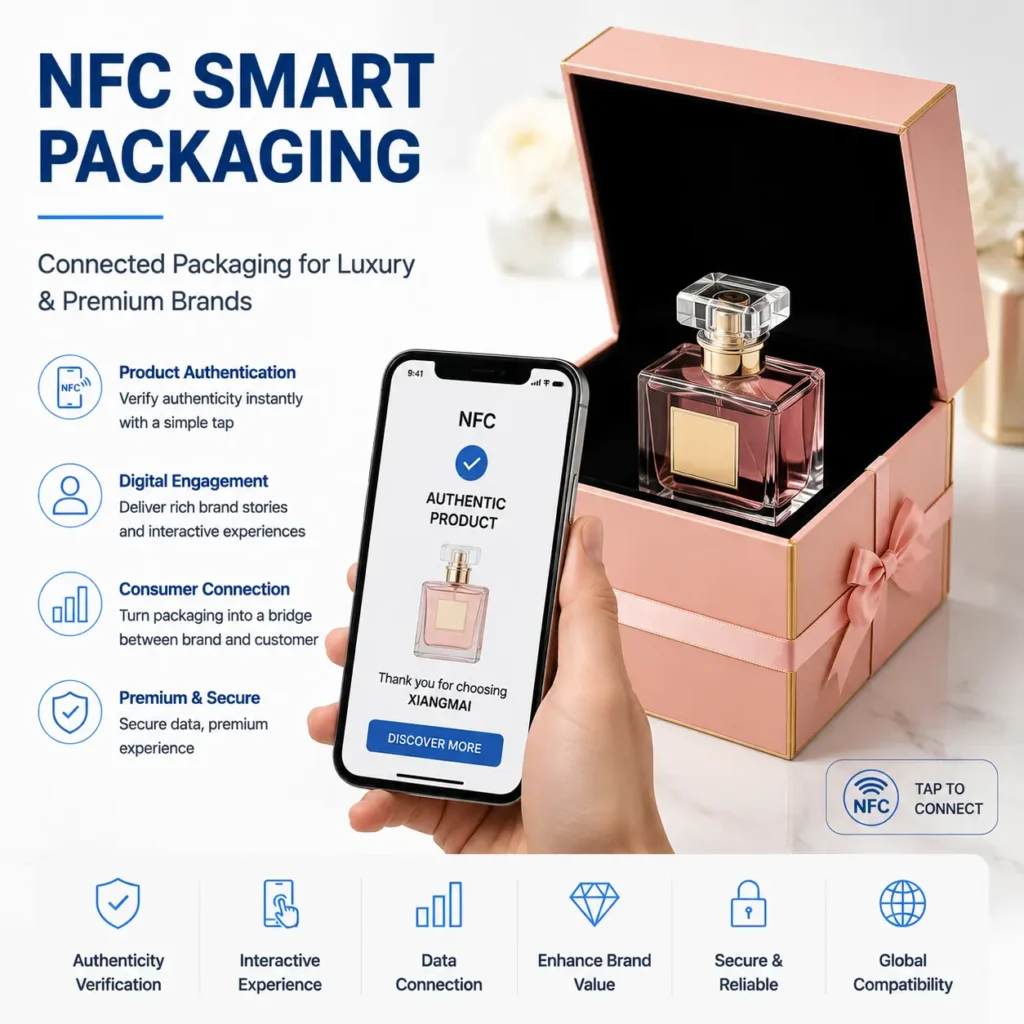
NFC smart packaging solution for luxury and beauty brands

What Is NFC Smart Packaging?

NFC smart packaging combines a physical package with an NFC component that can interact with a compatible NFC-enabled device.

Instead of treating the NFC component as a separate sticker added after packaging production, the inlay may be integrated into an approved area of the packaging structure.

Depending on the project, this can allow brands to connect physical packaging with buyer-defined digital content or product information while maintaining the intended packaging presentation.

Physical and Digital Scope

The NFC component is one part of the overall connected-product system. The destination website, digital platform, database, authentication logic and content-management system normally remain buyer- or technology-provider responsibilities unless separately agreed.

How NFC Is Integrated Into Packaging

The appropriate integration method depends on the package construction and the intended NFC interaction.

An NFC inlay may be evaluated for placement between suitable packaging layers or within another approved area of the package.

Important Engineering Factors

  • Available integration area
  • NFC inlay dimensions
  • Antenna position and orientation
  • Paper or board structure
  • Packaging thickness and surface treatments
  • Nearby conductive materials
  • Final product contents
  • Intended smartphone interaction
  • Assembly process and visual requirements

Hidden Integration Requires Validation

Hidden integration may be possible in suitable packaging structures, but the final position should be confirmed through sample evaluation.

Packaging containing metallic, metallized, magnetic, conductive or other performance-sensitive structures requires additional review.

NFC Smart Packaging Applications

Product Authentication-Related Applications

An NFC identity can form part of a buyer-defined product-verification or authentication workflow.

The NFC component itself should not be treated as a complete authentication system. The final workflow may also depend on the selected chip, encoded data, digital platform, security architecture and verification method.

Where authentication is an important project objective, these requirements should be identified before the NFC component and data structure are approved.

Consumer Engagement

NFC-enabled packaging may connect consumers with buyer-defined digital experiences using a compatible smartphone.

Possible project objectives may include access to product information, brand content, usage instructions, product registration, campaign pages, after-sales information or other buyer-managed digital content.

The destination content and digital platform should be defined separately from the physical packaging specification.

Connected Product Information

NFC packaging can provide a physical access point to digital product information.

Depending on the project, encoded information may direct the user to a fixed or buyer-defined destination.

Where each package requires an individual digital identity, the serialization and data relationship should be defined during project evaluation.

Premium Brand Experiences

For beauty, fragrance, luxury and other premium products, the NFC component may be evaluated for integration without making it a dominant visible element of the packaging.

The packaging design, NFC position and final product structure should be reviewed together so that appearance and NFC functionality can be evaluated during prototype development.

Packaging Structures We Can Evaluate

Folding Cartons

NFC integration may be evaluated for suitable folding-carton structures where sufficient component area and an appropriate inlay position are available.

The final solution should consider artwork, folds, glue areas, cutting lines, packaging assembly and the position of the product inside the carton.

Rigid Boxes and Gift Boxes

Rigid boxes and gift packaging may provide different integration possibilities depending on board construction, wrapping materials, internal components and decorative finishes.

The intended NFC position should be reviewed before the packaging structure is finalized whenever possible.

Beauty and Fragrance Packaging

Beauty, skincare, cosmetics and fragrance packaging frequently combines branding, decorative finishes and multiple packaging materials.

For NFC projects, metallic decoration, foil, metallized materials, product contents and component placement may affect performance and therefore require application-specific evaluation. Explore NFC Packaging for Beauty Brands.

Custom Packaging Structures

For non-standard packaging, Xiangmai can review the available structure and project information before recommending a prototype direction.

A complete finished 3D drawing is helpful but is not always required for an initial evaluation. Dimensions, materials, photographs, dielines, structural information and the intended NFC area can often support a preliminary review.

Final production specifications remain subject to prototype and engineering confirmation.

NFC Chip and Inlay Selection

NFC chip and inlay selection should be based on the actual application rather than selecting a component only by product name.

Factors may include:

  • Intended user interaction and required data
  • Memory and security requirements, if applicable
  • Available antenna area
  • Packaging structure and NFC placement
  • Target device environment
  • Project quantity and commercial requirements

Specific chip families, memory configurations, security functions and long-term availability should be confirmed for each project.

Xiangmai can review the available project information and recommend a component direction for prototype evaluation.

Encoding and Unique Data

NFC packaging projects may require encoded information to be coordinated with the physical package.

Depending on the approved project specification and component capability, encoding requirements may include a URL, unique URL, serial data, buyer-provided project data, product-related identifiers or other supported data structures.

Where unique data is required, the buyer should define the source data and the relationship between the physical package, printed information and encoded information.

Variable-Data Requirements

  1. Source-data format
  2. Printed fields
  3. Encoded fields
  4. Matching rules
  5. Duplicate-data rules
  6. Rejected-data handling
  7. Required verification scope

Digital hosting, redirects, databases, analytics and content management are separate from the physical NFC packaging and encoding scope unless specifically agreed.

What Affects NFC Read Performance?

NFC performance should be evaluated in the final application rather than assumed from an unattached inlay.

  • Chip and inlay selection
  • Antenna dimensions and orientation
  • Packaging material and thickness
  • NFC position
  • Nearby metal or conductive materials
  • Liquid-containing products
  • Decorative or metallized components
  • Final package construction
  • Product position inside the package
  • Smartphone or reading device

Test the Intended Packaging

For this reason, Xiangmai does not recommend relying on a fixed reading-distance claim before the intended packaging structure has been evaluated.

NFC Packaging Prototype Development

Prototype validation is an important part of NFC smart packaging development.

01

Requirement Review

Define the product, packaging structure, intended NFC interaction, target market and project objectives.

02

Packaging and Material Review

Review dimensions, materials, dielines, artwork, decorative finishes, product contents and available NFC placement area.

03

NFC Component Proposal

Evaluate an appropriate chip, antenna or inlay direction based on the available project information.

04

Sample Construction

Prepare a physical sample using the agreed preliminary packaging and NFC structure.

05

Functional Evaluation

Check the agreed NFC function and encoded information according to the prototype scope.

06

Buyer Application Testing

The buyer should evaluate the sample with the intended product, packaging configuration and target smartphones or other approved reading devices.

07

Revision if Required

Placement, component selection or packaging construction may be adjusted based on prototype results.

08

Approved Production Specification

Before production, confirm the approved NFC component, position, packaging structure, artwork, encoding requirements and inspection scope.

Sampling cost, quantity and timing should be confirmed for the individual project.

Manufacturing and Inspection

Xiangmai coordinates RFID/NFC production with related printed-packaging manufacturing processes in Huizhou, Guangdong.

Our manufacturing resources include RFID/NFC bonding, converting, encoding and inspection equipment together with printing and packaging-production capability.

This allows suitable projects to coordinate NFC inlay preparation, converting, encoding, printed packaging, NFC component integration, production-defined inspection and finished packaging preparation.

Detailed manufacturing information is available through our RFID/NFC Manufacturing Capability page and Xiangmai Factory page.

Project-Defined Inspection

Inspection criteria should be defined according to the approved production specification. No fixed inspection percentage or performance threshold should be assumed unless confirmed for the project.

Information Required for Evaluation

To evaluate an NFC smart packaging project efficiently, provide as much of the following information as possible:

  • Product category and target country or market
  • Packaging type and dimensions
  • Dieline, structural drawing or artwork, if available
  • Packaging materials and decorative finishes
  • Photos or reference samples
  • Product contents and nearby metal, liquid or conductive materials
  • Available NFC integration area and preferred position, if any
  • Intended smartphone interaction
  • Chip requirement, if already defined
  • Data, encoding or URL requirements
  • Variable printed-data and matching requirements
  • Prototype quantity, estimated production quantity and target timeline

If some technical details remain undecided, identify them for evaluation rather than estimating them.

Begin with Available Project Information

Dimensions, materials, application details, photographs and intended NFC interaction can support an initial technical review.

Send Your Packaging Structure

NFC Smart Packaging FAQ

It may be possible to integrate an NFC inlay within suitable packaging layers or structures. The available area, materials, antenna position and final package construction should be reviewed before the integration method is approved.
Paper and board can be suitable for NFC packaging applications, but actual performance depends on the complete structure, including the NFC component, material thickness, placement, nearby materials, product contents and smartphone. Prototype testing is recommended.
Metal, metallized layers and other conductive materials can influence NFC antenna performance. Packaging using these materials requires additional evaluation of the component, position and final structure.
The appropriate chip depends on the required data, interaction, available antenna area, packaging structure, security requirements where applicable, target device environment and project requirements. Chip selection should be confirmed during technical evaluation.
Unique or serialized data may be supported when the selected component and approved project specification allow it. The buyer should define the source data, data relationship and required digital destination.
Encoding can be included within an approved NFC packaging project when the required data format and component capability have been confirmed. Verification requirements should also be defined before production.
Existing packaging can be evaluated for NFC integration. Dimensions, materials, dielines, artwork, finishes, product contents and the available NFC area help determine whether the existing structure can be used or requires adjustment.
NFC performance is affected by the component, packaging material, placement, nearby materials, product contents and final construction. A physical prototype allows the proposed structure to be evaluated before the production specification is approved.

Request an NFC Packaging Sample

If you are developing NFC-enabled folding cartons, rigid boxes, gift packaging, beauty packaging or another custom packaging structure, send us the available project information for evaluation.

You do not need every technical detail to begin an initial discussion. Packaging dimensions, materials, application, photos, drawings and intended NFC interaction can help us identify the information still required for prototype development.

Request an NFC Packaging Sample Discuss Your NFC Packaging Project