PHYSICAL LABELS FOR PRODUCT AND PACKAGING PROTECTION

Custom Anti-Counterfeit Labels Manufacturer

Xiangmai manufactures custom anti-counterfeit and tamper-evident labels for brands, packaging manufacturers and solution providers that require physical product or packaging protection features.

Projects can combine printed label construction with RFID or NFC components, variable information, serialization, encoding or tamper-evident structures according to the approved application requirements.

The appropriate construction depends on the packaging surface, label position, required evidence of opening or removal, RFID/NFC requirements and the buyer’s wider authentication or brand-protection workflow.

No physical label alone should be assumed to prevent all counterfeiting or unauthorized product activity. The protection approach should be evaluated as part of the buyer’s overall product and packaging system.
Discuss Your Brand-Protection Project Send Your Label Requirements
RFID NFC anti-counterfeit and tamper-evident labels

Anti-Counterfeit Labels for Product and Packaging Protection

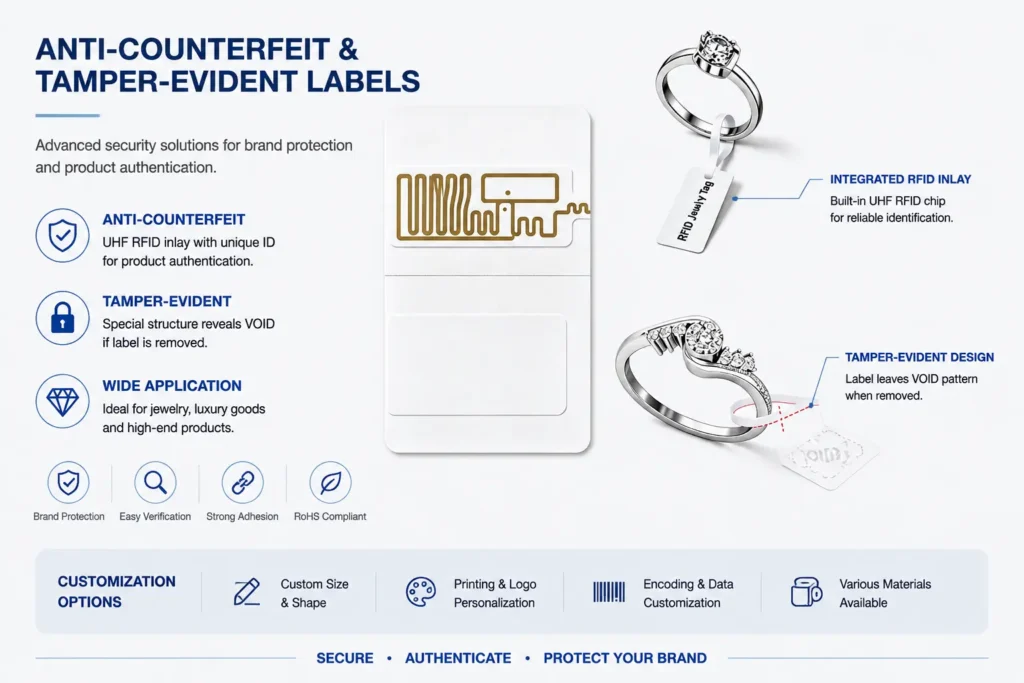
Anti-counterfeit labels can provide physical identification or evidence features that support a buyer’s broader product-protection strategy.

Depending on the project, a label may be designed to support objectives such as:

  • Product identification
  • Package identification
  • Evidence of label removal
  • Evidence of package opening
  • Serialized identification
  • RFID/NFC-enabled identification
  • Buyer-defined authentication workflows
  • Consumer or channel interaction when supported by the buyer’s digital system

The exact label construction should be selected according to the product, packaging material, application surface and intended protection objective.

A physical anti-counterfeit label is normally one component of a broader brand-protection process rather than a complete authentication system by itself.

Explore RFID Labels & Tags

Physical Tamper-Evident Label Construction

Tamper-evident labels are intended to provide visible or functional evidence when a label or protected package is opened, removed or disturbed, depending on the approved construction and application.

Project evaluation may consider structures such as:

  • Labels designed to show evidence after removal
  • Destructible or breakable constructions where technically suitable
  • Labels positioned across an opening point
  • RFID/NFC-enabled structures where physical damage may affect the electronic component
  • Custom die-cut constructions
  • Printed security-related visual elements where specified

The actual behavior depends on the selected material, adhesive, substrate, surface, label geometry, application method and environmental conditions.

Specific destructibility, residue behavior, adhesive strength, removal pattern or electronic failure behavior must be confirmed for the intended application.

Tamper-Evident vs. Tamper-Proof

A tamper-evident construction is designed to provide evidence of interference.

It should not automatically be described as “tamper-proof.”

The purpose is normally to make opening, removal or alteration more visible or detectable according to the approved label and packaging design.

RFID and NFC Integration Options

RFID or NFC components may be incorporated into an anti-counterfeit or tamper-evident label when electronic identification is part of the buyer’s project.

Depending on the application, the RFID/NFC component may support buyer-defined functions such as:

  • Electronic product identification
  • Serialized identification
  • NFC interaction
  • RFID-based identification
  • Connection to buyer-controlled product records
  • Authentication-related workflows
  • Opening or removal-related designs where technically validated

The RFID/NFC component, antenna construction and placement should be evaluated according to the label geometry and final packaging environment.

Specific frequency, protocol, chip, memory, security functions, password features, locking behavior or tamper-related electronic response remain subject to technical confirmation.

Electronic Tamper-Related Designs

Some projects may require the RFID/NFC antenna or circuit structure to interact with the physical opening or removal point.

Such designs require application-specific evaluation.

Whether opening, cutting, tearing or removal changes the RFID/NFC response depends on the approved antenna/circuit design, label construction and placement.

A specific “cut = no signal” or similar behavior must not be guaranteed without prototype testing and technical confirmation for the actual product.

View RFID/NFC Inlay Manufacturing

Printing, Serialization and Variable Data

Anti-counterfeit labels may include visible information according to the approved artwork and project requirements.

Depending on the project, printed or variable elements may include:

  • Brand graphics
  • Product information
  • Serial numbers
  • Batch-related information
  • Barcodes
  • QR codes
  • Buyer-defined variable data
  • Other approved printed identifiers

Where RFID/NFC encoding is required, the buyer should define the required relationship between printed information and encoded information.

Printed and Electronic Data Matching

Projects requiring printed and RFID/NFC data coordination should define:

  1. Source-data file
  2. Printed fields
  3. Encoded fields
  4. Unique-data requirements
  5. Matching rules
  6. Duplicate-data rules
  7. Rejected-data handling
  8. Required production report
  9. Verification scope

The connection between a physical label identity and the buyer’s external authentication database, website, application or product platform normally remains buyer- or solution-provider defined unless separately agreed.

Anti-Counterfeit Label Applications

Custom anti-counterfeit and tamper-evident labels may be evaluated for different products and packaging structures.

Beauty, Cosmetics and Fragrance

Labels may be incorporated into suitable beauty, cosmetics, perfume or fragrance packaging where brands require physical tamper evidence, serialized identification, NFC interaction or other buyer-defined protection features. Explore NFC Packaging for Beauty Brands.

Luxury and Premium Products

Premium products may use physical labels as part of a broader identification, authentication or connected-product strategy.

Apparel and Fashion

RFID/NFC-enabled or serialized labels may support buyer-defined product-identification and brand-protection workflows for apparel, footwear and accessories.

Consumer Electronics

Labels may be evaluated for packaging seals, product identification or other suitable applications depending on the surface and product construction.

Other Packaged Products

Other products may be evaluated where the packaging structure and application surface are compatible with the required label construction.

Final suitability should be determined from the actual product and packaging environment rather than from the industry category alone.

Label Placement and Packaging Environment

Anti-counterfeit and tamper-evident performance depends strongly on where and how the label is applied.

Relevant factors may include:

  • Packaging material
  • Surface coating
  • Surface energy
  • Curved or flat surface
  • Label dimensions
  • Label shape
  • Application position
  • Opening point
  • Application pressure
  • Application temperature
  • Storage environment
  • Transportation conditions
  • Nearby metal
  • Nearby liquid
  • Folding or bending
  • RFID/NFC antenna position where applicable

For tamper-evident projects, the label should be evaluated on the actual or representative packaging surface.

For RFID/NFC-enabled projects, electronic performance should also be tested in the intended product and reading environment.

Explore NFC Smart Packaging

Inspection and Verification

Anti-counterfeit label production may include inspection steps according to the approved project specification.

Depending on the project, inspection may cover:

  • Printed appearance
  • Variable-data presence
  • Serial-data verification
  • RFID/NFC response where applicable
  • Encoded-data verification
  • Printed/encoded data relationship
  • Die-cut or finished construction
  • Tamper-evident construction
  • Packing requirements

The exact inspection method, sampling level and acceptance criteria should be agreed for the specific project.

No fixed inspection percentage, adhesive performance, tamper behavior or RFID/NFC performance should be assumed unless specifically confirmed.

Sample and Application Evaluation

Sampling is particularly important for anti-counterfeit and tamper-evident labels because the final packaging surface and opening method can affect performance.

1. Protection Objective Review

Define what the label is expected to support, such as identification, removal evidence, opening evidence, serialization or RFID/NFC interaction.

2. Packaging Review

Review the box, bottle, container, bag, product or other application surface.

3. Label Position Review

Confirm where the label will be applied and how the package or product will be opened or handled.

4. Construction Review

Evaluate the proposed label structure, dimensions, material requirements, adhesive requirements and RFID/NFC component where applicable.

5. Data Review

Confirm printed information, serial numbers, barcode/QR requirements and RFID/NFC encoding requirements where applicable.

6. Prototype Development

Prepare samples according to the confirmed prototype specification.

7. Application Testing

The buyer should apply and evaluate samples on the actual or representative product or packaging.

For RFID/NFC-enabled projects, the buyer should also evaluate electronic performance in the intended reader or smartphone environment.

8. Production Specification Approval

Record the approved label construction, placement, artwork, variable data, RFID/NFC component, encoding and inspection requirements before mass production.

Sample quantity, cost and lead time should be confirmed for the specific project.

Anti-Counterfeit Label Manufacturing Process

Depending on the approved specification, a project may move through the following stages:

  1. Application and protection-objective review
  2. Packaging and placement review
  3. Label construction evaluation
  4. RFID/NFC component evaluation where required
  5. Artwork and data preparation
  6. Printing and converting
  7. RFID/NFC integration where required
  8. Encoding or variable-data processing where required
  9. Inspection and verification
  10. Finished-label preparation
  11. Packing according to the approved requirement

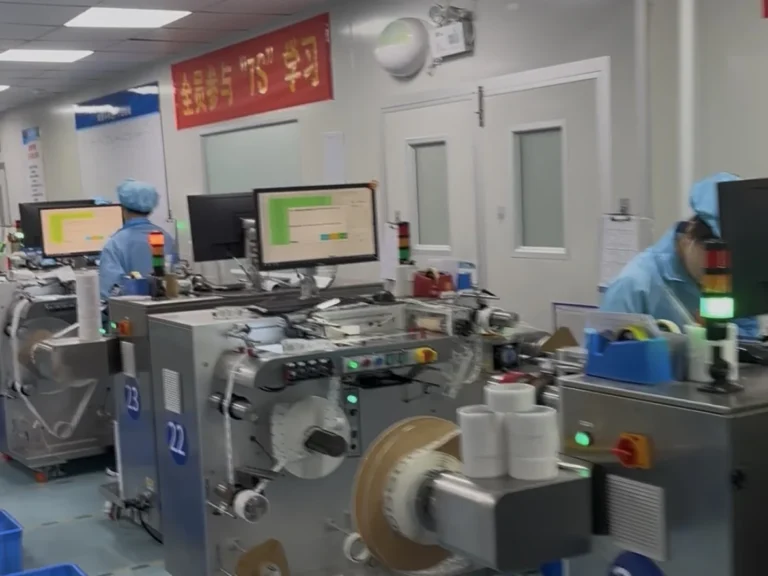
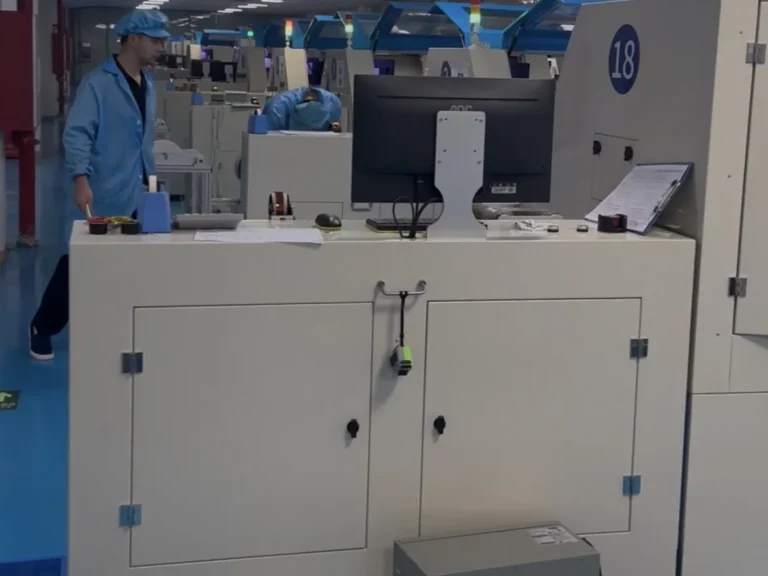
Xiangmai’s RFID/NFC manufacturing capability includes inlay-related production, converting, encoding, inspection and integration with printed products.

For additional production information, see RFID/NFC Manufacturing Capability.

View Xiangmai Factory Capability

Information Required for Quotation

For an efficient anti-counterfeit or tamper-evident label evaluation, provide as much of the following information as possible:

  • Product category and target market
  • Protection objective
  • Product or packaging type
  • Packaging material and surface type or coating
  • Label application position and opening method
  • Required label dimensions and shape
  • Artwork and printing requirements
  • Variable-data, serial-number, barcode and QR code requirements
  • Tamper-evident requirement and desired removal/opening evidence
  • RFID or NFC requirement, if applicable
  • Required frequency/protocol or chip, if already specified
  • Encoding and printed/encoded matching requirements
  • Existing digital authentication system information, if applicable
  • Sample quantity and estimated production quantity
  • Packing requirement and project timeline

If the material, adhesive, RFID/NFC component or tamper structure has not yet been defined, provide the actual product, packaging structure and protection objective for evaluation rather than estimating the technical parameters.

Prepare Your Inquiry

Sharing the actual packaging and intended protection objective helps identify the technical items that require evaluation before sampling.

Send Your Label Requirements

Anti-Counterfeit Labels FAQ

An anti-counterfeit label is a physical label used as part of a product-identification or brand-protection strategy. Depending on the project, it may incorporate printed identifiers, serialization, tamper-evident construction or RFID/NFC components.

A tamper-evident label is designed to provide visible or functional evidence when the label or protected package is removed, opened or disturbed according to the approved construction and application.

No. Tamper-evident means the construction is intended to show evidence of interference. It should not be assumed to make a package impossible to open or alter.

RFID or NFC components can be evaluated for suitable anti-counterfeit and tamper-evident label projects. Component selection, antenna design, placement and electronic behavior should be confirmed according to the specific application.

This is possible only with a suitable project-specific antenna or circuit construction and placement. The exact behavior must be evaluated and tested for the actual label and packaging design rather than assumed for every RFID/NFC label.

Buyer-defined serial numbers, QR codes, barcodes and other variable printed information may be included according to the approved artwork and data requirements.

Printed and encoded data can be coordinated when the buyer defines the source data, matching relationship and required verification scope. Specific RFID/NFC data functions remain subject to technical confirmation.

This page covers physical label manufacturing and related approved RFID/NFC production processes. Any website, database, software platform or authentication system should be defined separately and is not automatically included with the physical label.

Sampling is recommended, particularly when tamper behavior, adhesive performance, packaging compatibility or RFID/NFC performance must be evaluated. Samples should be tested on the intended or representative product and packaging.

Discuss Your Brand-Protection Project

Share your product, packaging structure, protection objective, label position, dimensions, artwork, tamper-evident requirements, RFID/NFC requirements, variable data, sample quantity and estimated production quantity with the Xiangmai team.

If the label construction, adhesive, RFID/NFC component or electronic tamper behavior has not yet been defined, provide the actual application information. The technical items requiring evaluation can then be identified before sampling.

Discuss Your Brand-Protection Project Request Anti-Counterfeit Label Samples