
FINISHED NFC LABELS FOR PRODUCTS AND PACKAGING

Custom NFC Smart Labels Manufacturer

Xiangmai manufactures custom NFC smart labels for brands, packaging manufacturers, product manufacturers and solution providers that require NFC functionality in a finished label format.

Projects can combine printed label construction with an NFC component, buyer-defined data, serialization, encoding and converting according to the approved application requirements.

NFC labels can be evaluated for product identification, digital interaction, connected-product experiences, product information and buyer-defined authentication-related workflows.

Because NFC performance depends on the NFC component, antenna design, label construction, placement and final product environment, the appropriate configuration should be confirmed for the specific application before mass production.
Request NFC Label Samples
custom printed NFC smart labels

NFC Smart Labels for Connected Products and Packaging

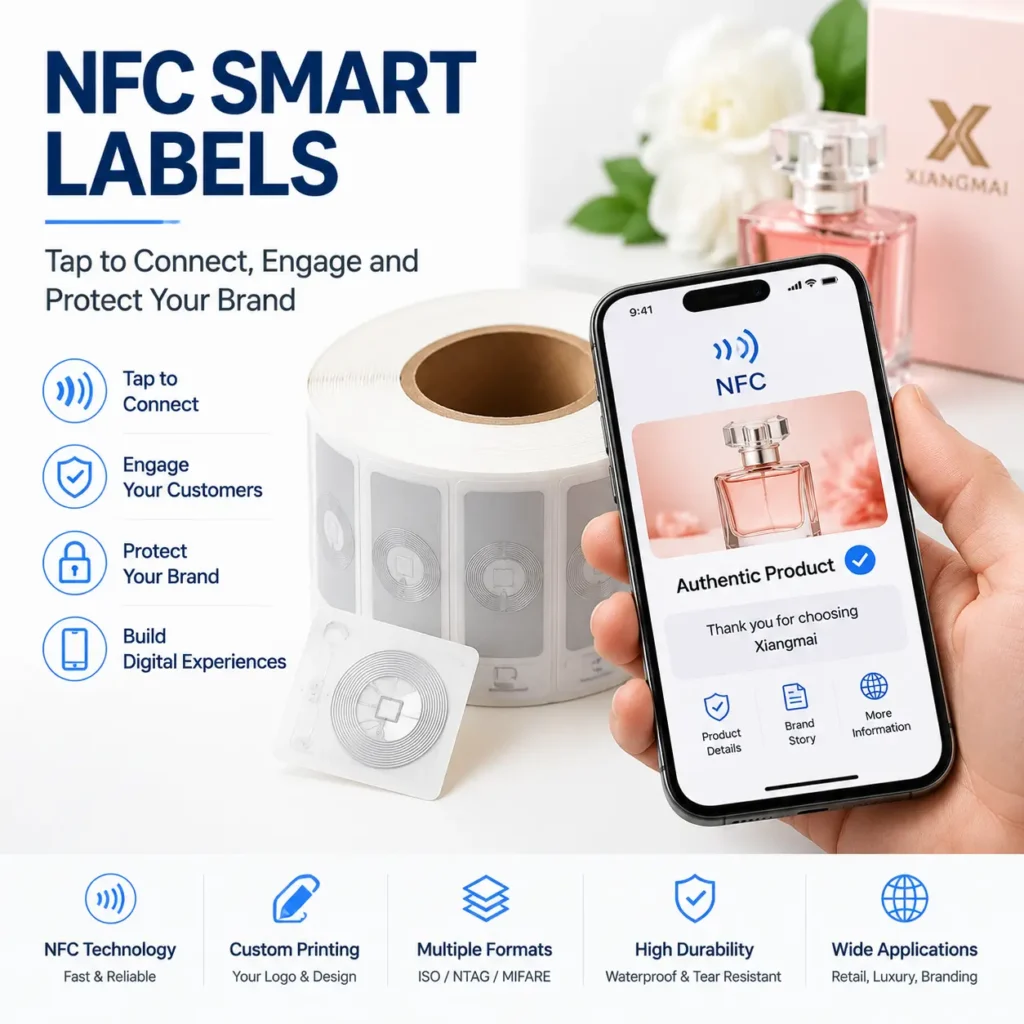
An NFC smart label combines a physical label with an NFC component so that a compatible device can interact with the label according to the approved NFC configuration and buyer-defined digital workflow.

Depending on the project, NFC labels may support applications such as:

  • Product identification
  • Product information
  • Digital content access
  • Buyer-defined URL interaction
  • Connected-product experiences
  • Serialized product identification
  • Marketing or engagement workflows
  • Authentication-related workflows
  • Packaging interaction

The NFC label itself provides the physical NFC interface.

The website, database, application, authentication platform or other digital destination connected to the NFC interaction remains buyer- or solution-provider defined unless separately agreed.

For projects where NFC is integrated directly into the packaging structure rather than supplied as a finished label, see NFC Smart Packaging.

Custom NFC Label Construction

The physical construction of an NFC label should be selected according to the final application.

Project evaluation may consider:

  • Finished label dimensions
  • Label shape
  • Available antenna area
  • Face material requirements
  • Printing requirements
  • Adhesive requirements
  • Liner requirements
  • NFC component placement
  • Label application surface
  • Product or packaging structure
  • Roll or sheet format
  • Downstream application method
  • Packing requirements

The exact face material, adhesive, liner, thickness, tolerances and finished construction should be confirmed for the project.

Printed and Unprinted NFC Labels

Depending on the buyer’s downstream process, an NFC label project may require printed finished labels or another approved converted format.

Where printing is required, artwork, variable data and the relationship between printed information and NFC data should be defined before production.

NFC Chip and Antenna Requirements

The NFC component should be selected according to the intended application rather than from label dimensions alone.

Relevant project factors may include:

  • Intended NFC function
  • Target market
  • Available antenna area
  • Label dimensions
  • Product material
  • Packaging material
  • Label placement
  • Nearby conductive materials
  • Smartphone interaction requirements
  • Required data
  • Memory requirements
  • Security requirements where applicable
  • Final product environment

Where the buyer already has a specified NFC chip, standard, memory requirement or other technical specification, that information should be supplied for review.

Where the NFC component has not yet been selected, the intended application and known system requirements should be evaluated before a specific configuration is confirmed.

Specific chip models, NFC Forum types, protocols, memory configurations, security functions and password/locking features remain subject to project confirmation.

For buyers requiring the NFC component for their own converting or product integration rather than a finished label, see RFID/NFC Inlay Manufacturing.

NFC Encoding and Variable Data

Where required, NFC labels may be prepared with buyer-defined encoded data according to the approved specification and the capabilities of the selected NFC component.

Possible project requirements may include:

  • Buyer-defined URL
  • Serialized URL
  • Unique product identifier
  • Buyer-defined text or data
  • Data associated with a buyer-controlled product record
  • Other approved NFC content

The exact data structure should be confirmed before production.

Specific UID handling, memory allocation, passwords, locking, cryptographic functions or other chip-level operations should not be assumed unless technically reviewed and approved for the selected component.

Unique Data and Production Records

Where individual NFC labels require unique data, the buyer should define the required data relationship before production.

  1. Source-data format
  2. Unique-data rules
  3. Required encoded fields
  4. Printed-data fields
  5. Printed/encoded matching requirements
  6. Duplicate-data rules
  7. Rejected-data handling
  8. Required production report
  9. Verification scope

The connection between the NFC identity and an external website, database, authentication platform or application normally remains buyer- or solution-provider controlled unless separately agreed.

Printing and Label Converting

NFC smart labels can combine NFC functionality with printed label production according to the approved project requirements.

Depending on the project, manufacturing may involve:

  • Artwork preparation
  • Printed brand graphics
  • Product information
  • Variable printed data
  • Serial numbers
  • QR codes or barcodes where required
  • NFC component integration
  • Label converting
  • Die-cutting
  • Encoding
  • Inspection
  • Finished roll, sheet or other approved preparation

The exact printing process, materials, finishing processes, dimensions, tolerances and packing format should be confirmed according to the specific label specification.

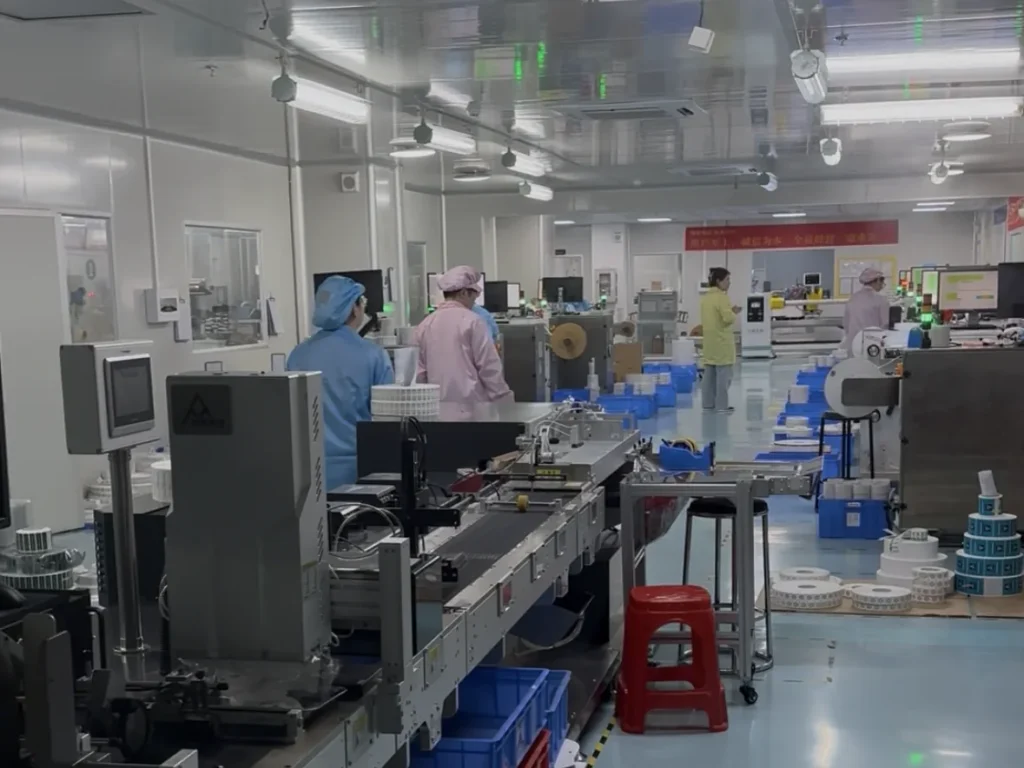
RFID NFC encoding workstation at Xiangmai factory

Applications for NFC Smart Labels

NFC labels can be evaluated for a range of product and packaging applications.

Beauty, Cosmetics and Fragrance

NFC labels may be applied to suitable beauty, cosmetics, skincare, perfume or fragrance products and packaging for buyer-defined product information, interaction, identification or authentication-related workflows. Explore NFC Packaging for Beauty Brands.

Luxury and Premium Products

Premium-product brands may use NFC labels as part of connected-product, product-information or brand-protection strategies.

Apparel and Fashion

NFC labels may support buyer-defined digital interaction, product information or identification applications for apparel, footwear and accessories.

Consumer Electronics

NFC labels can be evaluated for suitable electronics products or packaging where the application surface and product environment support the proposed NFC construction.

Food, Beverage and Other Packaged Products

NFC labels may also be evaluated for other suitable packaged products where the label construction, placement and operating environment are technically appropriate.

Final suitability should be evaluated according to the actual product and packaging rather than industry category alone.

Label Placement and NFC Performance

NFC performance depends on the complete label and product environment.

Relevant factors may include:

  • NFC chip
  • Antenna design
  • Antenna dimensions
  • Label dimensions
  • Label construction
  • Product material
  • Packaging material
  • Application position
  • Distance from the product surface
  • Nearby metal
  • Nearby conductive materials
  • Nearby liquids
  • Folding or bending
  • Adhesive and lamination layers
  • Smartphone model
  • Smartphone NFC antenna position
  • User interaction position
  • Final operating environment

For this reason, a fixed smartphone read distance or universal device compatibility should not be assumed from the NFC label specification alone.

Where NFC interaction is important to project approval, samples should be tested on the actual or representative product and packaging using the intended device environment.

Inspection and Data Verification

NFC smart-label production may include inspection and verification according to the approved project requirements.

Depending on the project, inspection may cover:

  • Printed appearance
  • Label construction
  • Finished dimensions
  • NFC response
  • Encoded-data verification
  • Variable-data verification
  • Printed/encoded data relationship
  • Roll or sheet preparation
  • Packing requirements

The exact inspection method, sampling level and verification scope should be agreed for the specific project.

No universal inspection percentage, encoding accuracy, smartphone performance or read-distance guarantee should be assumed unless specifically confirmed.

Sample and Prototype Evaluation

Sampling is recommended when NFC performance, label construction, placement, encoding or final product compatibility must be evaluated before mass production.

A typical project may include:

1. Application Review

Confirm the product or packaging on which the NFC label will be used and the intended NFC function.

2. Product and Surface Review

Review the product material, packaging material, available label area, application surface and nearby materials.

3. NFC Requirement Review

Review known chip, memory, technical, data or smartphone requirements where available.

4. Label Construction Review

Confirm dimensions, shape, printing, adhesive, liner and other required construction details.

5. Data Review

Confirm URL, serialization, variable data, printed-data and encoding requirements where applicable.

6. Prototype Specification

Define the proposed NFC label configuration for sampling.

7. Sample Production

Prepare samples according to the confirmed prototype specification.

8. Buyer Testing

The buyer should test samples on the actual or representative product and packaging using the intended smartphone or other approved NFC environment.

9. Production Specification Approval

Confirm the approved NFC component, antenna/inlay configuration, label construction, artwork, encoded data, variable data and inspection requirements before mass production.

Sample quantity, sample cost and lead time should be confirmed for the specific project.

NFC Smart Label Manufacturing Process

Depending on the approved specification, an NFC smart-label project may move through the following stages:

  1. Application and specification review
  2. NFC component evaluation
  3. Label construction confirmation
  4. Artwork and data preparation
  5. NFC component/inlay-related production
  6. Printing and converting
  7. NFC integration
  8. Encoding where required
  9. Variable-data processing where required
  10. Inspection and verification
  11. Finished-label preparation
  12. Packing according to the approved requirement

Xiangmai’s broader RFID/NFC manufacturing capability includes inlay-related production, converting, encoding, inspection and integration with printed products.

For additional production information, see RFID/NFC Manufacturing Capability.

Information Required for Quotation

For an efficient NFC smart-label evaluation, provide as much of the following information as possible:

  • Intended application, product category and target market
  • Product or packaging type and material
  • Label application surface and position
  • Required label dimensions and shape
  • Artwork and printing requirements
  • Required NFC chip or technical requirements, if already specified
  • Memory or smartphone requirement, if applicable
  • URL, data, unique-data and serialization requirements
  • Printed variable-data and printed/encoded matching requirements
  • Existing digital platform information, if applicable
  • Adhesive and liner requirements, if applicable
  • Roll or sheet requirement
  • Sample quantity and estimated production quantity
  • Packing requirement and project timeline

If the NFC chip, antenna, adhesive or other technical configuration has not yet been defined, provide the intended application and actual product/packaging information rather than estimating the missing specifications.

Prepare Your Inquiry

Share the intended application and known product information so the technical items requiring evaluation can be identified before sampling.

Send Your NFC Label Requirements

NFC Smart Labels FAQ

An NFC smart label combines an NFC component with a finished label construction so that a compatible NFC device can interact with the label according to the approved configuration and digital workflow.

An NFC inlay is primarily the functional chip-and-antenna component intended for further converting or integration. An NFC smart label is a finished label construction prepared for the intended product or packaging application.

An NFC smart label is a finished NFC-enabled label that can be applied to a suitable product or package. NFC smart packaging involves integrating the NFC component into the packaging structure itself.

Buyer-defined URL content may be encoded where supported by the selected NFC component and approved project specification. The destination website itself remains buyer- or solution-provider controlled unless separately agreed.

Projects requiring unique or serialized NFC data can be evaluated according to the selected component and approved data specification. The source data, uniqueness rules, matching requirements and verification scope should be defined before production.

Printed and encoded data can be coordinated when the required source data, matching relationship and verification scope are defined before production.

The appropriate component depends on the intended application, required data, available antenna area, product material, placement, smartphone requirements and any required technical or security functions. A specific chip should be confirmed after these requirements are reviewed.

There is no single read distance applicable to every NFC label. Performance depends on the NFC component, antenna design, label construction, placement, nearby materials and smartphone hardware. Project-specific testing is recommended.

Metal, liquids and other conductive materials can affect NFC performance. The proposed label construction and placement should be evaluated for the actual product environment. A specialized construction should not be assumed unless technically confirmed.

This page covers physical NFC label manufacturing and related approved encoding and data-production processes. Websites, databases, authentication platforms, applications, APIs and analytics should be defined separately and are not automatically included with the physical NFC label.

Yes. Sampling is recommended when the buyer needs to evaluate dimensions, printing, placement, encoding, smartphone interaction or compatibility with the intended product and packaging. Sample quantity, cost and lead time should be confirmed for each project.

Request NFC Label Samples

Share your product or packaging structure, label dimensions, application position, artwork, known NFC requirements, URL/data requirements, variable-data requirements, sample quantity and estimated production quantity with the Xiangmai team.

If the NFC chip, antenna configuration or label construction has not yet been finalized, provide the intended application and known product requirements. The technical items requiring further evaluation can then be identified before sampling.

Request NFC Label Samples Discuss Your NFC Label Project