
FINISHED RFID HANG TAGS FOR APPAREL AND RETAIL

RFID Smart Hang Tags Manufacturer

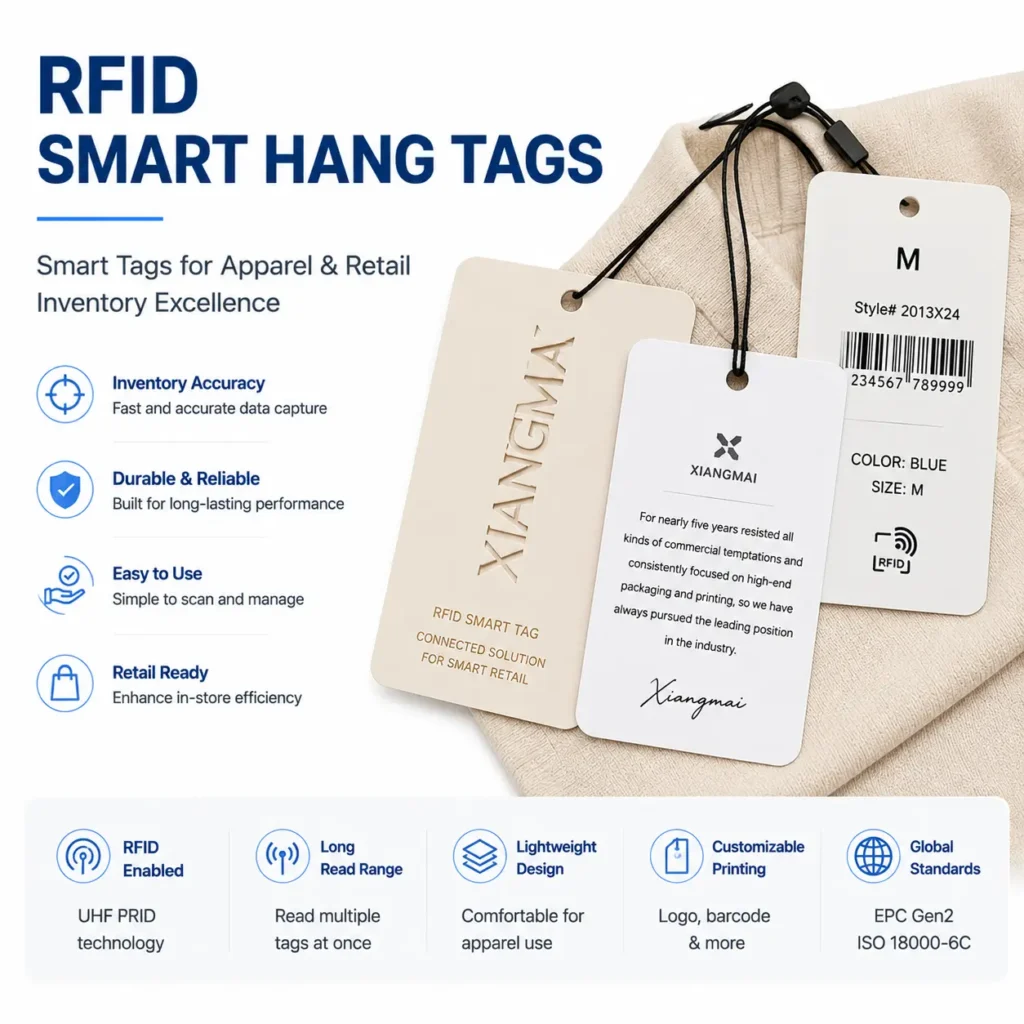
Xiangmai manufactures custom RFID smart hang tags for apparel, fashion and retail applications, combining printed product information with an RFID component in a finished hang-tag format.

Projects can include custom printing, variable product data, barcode or QR code printing, RFID encoding, converting and production-defined inspection according to the approved specification.

RFID performance and data requirements should be evaluated according to the product, tag construction, reader environment and intended workflow before mass production.
Discuss Your Apparel RFID Project
RFID smart hang tags for apparel and retail

RFID Hang Tags for Apparel and Retail

RFID smart hang tags combine a conventional printed hang tag with an RFID inlay or other approved RFID component.

They can be evaluated for apparel, footwear, fashion accessories, sportswear, retail merchandise and other products that already use a removable hang tag.

The appropriate construction depends on the product, attachment method, printed information, RFID requirements and the environment in which the tag will be read.

Part of the Buyer’s RFID Environment

The RFID hang tag itself is one part of the overall RFID system. Readers, software, product master data and operational integration normally remain buyer- or solution-provider led unless separately agreed.

Custom RFID Hang Tag Construction

A finished RFID hang tag may combine several physical and data elements according to the approved project specification.

Possible Project Elements

  • Printed hang-tag structure
  • RFID inlay
  • Brand artwork and product information
  • Variable data, barcode or QR code
  • Attachment feature and finished converting
  • Encoded RFID data

Tag dimensions, materials, inlay selection, attachment method and finishing requirements should be confirmed for each project rather than assumed from a standard format.

RFID Component Selection

The RFID component should be evaluated according to the required application, available tag area, product type, tag dimensions, placement, reader environment, required data, encoding specification and packing or handling conditions.

Specific frequency, protocol, chip, memory and performance requirements remain subject to technical confirmation.

Printing and Variable Product Data

RFID hang tags often need to carry the same visible product information already used in apparel and retail operations.

Depending on the approved artwork and data specification, printed information may include brand graphics, product name, style, SKU, size, color, serial number, barcode, QR code and buyer-provided variable information.

Source Data and Matching Rules

Printing requirements should be confirmed from approved artwork, dielines and source-data files. Where variable data is required, the buyer should define the source file, required printed fields and matching rules before production.

RFID Encoding and Data Matching

RFID data may be encoded according to an approved project specification and the capabilities of the selected RFID component. Depending on the project, encoded information may include an approved RFID identifier, serialized information or buyer-defined data.

Specific EPC, memory, TID, password, locking or other chip-level requirements should not be assumed and must be technically confirmed where required.

Printed and Encoded Data Matching

  1. Source-data file
  2. Printed fields
  3. Encoded fields
  4. Matching relationship
  5. Duplicate-data rules
  6. Rejected-data handling
  7. Required verification scope

For example, a buyer may require visible SKU, size, color, barcode or serial information to correspond with approved encoded data. The relationship between the RFID identity and the buyer’s product database or inventory system remains buyer- or solution-provider defined.

Applications for RFID Smart Hang Tags

RFID smart hang tags may support buyer-defined identification and operational workflows when used with compatible RFID infrastructure.

Item-Level Identification

An RFID identity can be associated with an individual garment or retail item according to the buyer’s data structure.

Inventory Workflows

RFID hang tags may be evaluated for stock-counting or inventory-related processes where appropriate readers, software and operating procedures are available.

Receiving and Shipment

Tagged products may support buyer-defined receiving, picking, packing or shipment-verification workflows.

Retail Operations

Retailers may evaluate RFID hang tags for inventory visibility, replenishment and other item-level workflows.

Actual system performance depends on the complete RFID environment and should be validated in the intended application. Explore RFID Tags for Apparel & Fashion.

RFID Performance and Product Environment

RFID performance cannot be determined only from the printed hang-tag dimensions.

Relevant factors may include RFID component selection, antenna dimensions, tag construction, product material, tag position, attachment method, nearby conductive materials, packing density, carton configuration, reader type, reader antenna arrangement, reading orientation and the final operating environment.

Project-Specific Testing

Fixed read distance, bulk-reading speed or accuracy should not be assumed before project-specific evaluation.

Samples should be tested with the buyer’s actual product and intended RFID environment where performance is important to project approval.

Inspection and Verification

RFID hang-tag production may include inspection steps defined by the approved project requirements.

Depending on the project specification, the inspection scope may cover printed appearance, variable-data presence, RFID response, encoded-data verification, printed/encoded data relationship, finished tag construction and packing requirements.

The exact inspection method, sampling level or verification scope should be confirmed before production. No fixed inspection percentage or universal performance standard should be assumed unless specifically agreed for the project.

Sample and Project Evaluation

Sampling is recommended before mass production when RFID construction, printing, encoding or application performance needs to be confirmed.

1. Requirement Review

Confirm the product, application, tag format, target market and available RFID system information.

2. Artwork and Structure Review

Review tag size, artwork, material requirements, attachment method and available RFID component area.

3. RFID Requirement Review

Confirm known frequency, protocol, chip, memory, encoding or reader requirements. Undecided parameters are identified for technical review.

4. Data Review

Confirm printed fields, barcode or QR requirements, variable data and encoded-data relationships.

5. Sample Development

Prepare samples according to the confirmed prototype specification.

6. Buyer Evaluation

Evaluate samples with the actual product, reader environment and intended process where applicable.

7. Specification Approval

Record the approved construction, artwork, RFID component, data, encoding and inspection requirements before production. Sample quantity, cost and lead time should be confirmed for each project.

RFID Hang Tag Manufacturing Process

A project may move through requirement and artwork review, RFID component evaluation, printing preparation, RFID integration and converting, variable-data printing where required, encoding where required, inspection and verification, finished-tag preparation and packing according to the approved requirement.

Xiangmai’s broader RFID/NFC Manufacturing Capability includes inlay-related production, converting, encoding, inspection and integration with printed products.

View Factory Capability

Information Required for Quotation

For an efficient evaluation, provide as much of the following information as possible:

  • Product category, target market and intended RFID application
  • Existing RFID system information, frequency, protocol or chip requirement if already specified
  • Hang-tag dimensions, dieline, artwork and material requirements
  • Printing, finishing and attachment requirements
  • SKU, size, color, barcode, QR code and variable-data requirements
  • Encoding and printed/encoded matching rules
  • Sample quantity and estimated order quantity
  • Packing requirements and project timeline

If some RFID specifications remain undecided, provide the known application and system information for technical evaluation rather than guessing the parameters.

Ready to Share Your Specification?

Send the available tag, artwork, RFID and project information for review.

Send Your Hang Tag Specifications

RFID Smart Hang Tags FAQ

An RFID smart hang tag combines a printed hang tag with an RFID component so that visible product information and an RFID identity can be incorporated into one finished tag.
RFID hang tags can be evaluated for apparel, footwear, fashion accessories and other retail products that use a suitable hang-tag format. Final suitability depends on the product, attachment method and RFID environment.
Yes, finished hang-tag projects may include buyer-approved artwork and variable product information according to the confirmed printing specification.
These fields may be included when supplied in an approved artwork or variable-data file and when the required printing and matching rules are defined.
Printed and encoded data can be coordinated when the buyer supplies an approved source-data file and defines the required relationship and verification scope. Specific encoded-data requirements remain subject to technical confirmation.
Chip selection depends on the RFID system, data requirements, tag construction, available area and intended application. A specific chip or memory configuration should be confirmed from the project requirements rather than assumed.
There is no single read distance applicable to every hang tag. Performance depends on the RFID component, tag construction, product, placement, reader environment and other application conditions. Project-specific testing is recommended.
Sampling can be used to evaluate tag construction, printing, encoding and application performance before production. Sample quantity, cost, timing and evaluation requirements should be confirmed for the specific project.

Discuss Your Apparel RFID Project

Share your hang-tag dimensions, artwork, product information, RFID requirements, variable data, encoding requirements, sample quantity and estimated production quantity with the Xiangmai team.

If some RFID parameters have not yet been defined, provide your product, intended workflow and existing reader or system information. We can identify which technical items require further evaluation before sampling.

Discuss Your Apparel RFID Project Request RFID Hang Tag Samples